


















![Hosting the SCLA Casptone Mentor Dinner outside allowed for more attendees on September 27, 2021 at Silver Creek. This event would’ve usually been held inside. According to Lauren Kohn, a SCLA 12 teacher, “If we have a higher number of people, as long as we can host the event outside, then that seems to be keeping every[one] safe”.](https://schsnews.org/wp-content/uploads/2021/11/sxMAIGbSYGodZkqmrvTi5YWcJ1ssWA08ApkeMLpp-900x675.jpeg)

When looking at all of the courses offered for the upcoming year, it’s obvious that the bolt for Advanced Placement (AP) math classes have become an unspoken competition for gaining the highest Grade Point Average (GPA). Freshman eye Calculus from afar; juniors prepare for Pre-Calculus; and seniors look for something that might push their GPA a tenth of a point higher.
Though AP math courses offer college preparation and credit, their standardized curriculum and accelerated pace can constrict what teachers can teach and which students can learn. At Silver Creek High School, the elimination of honors classes, past junior year, has left students with no choice between the AP pace and on-level courses, creating a gap that limits opportunity for middle-ground learners.
Upperclassmen at Silver Creek can be affected by the different kinds of stress that AP math classes can impose, given the limited options of less advanced courses.
One of the biggest fears surrounding AP classes is the weight of the AP exam at the end of the year, which tests all of the knowledge gained during the year in a two-to-three hour exam. For many students, the stress can put a lot of pressure on them to pass, as failing can feel like the class isn’t worthwhile.
”If you’re not wanting to take [the AP test], that defeats the point of the AP class,” Hailey Novacek, a junior taking Algebra II at Silver Creek, said.
For students committed to the AP track, the rigor ramps up significantly at advanced levels. Those who take the higher math classes are also able to experience the college workload firsthand.
“AP Calculus is more rigorous than AP Pre-Calculus by far, and it’s definitely a step up from any other class because it’s the first math class that is a true college-level class,” Tammi Vo, a junior in AP Calculus, said.
However, there are additional benefits that come with choosing the challenging path of AP math. Another benefit is adapting to how college students learn, as well as being introduced to a new style of education.
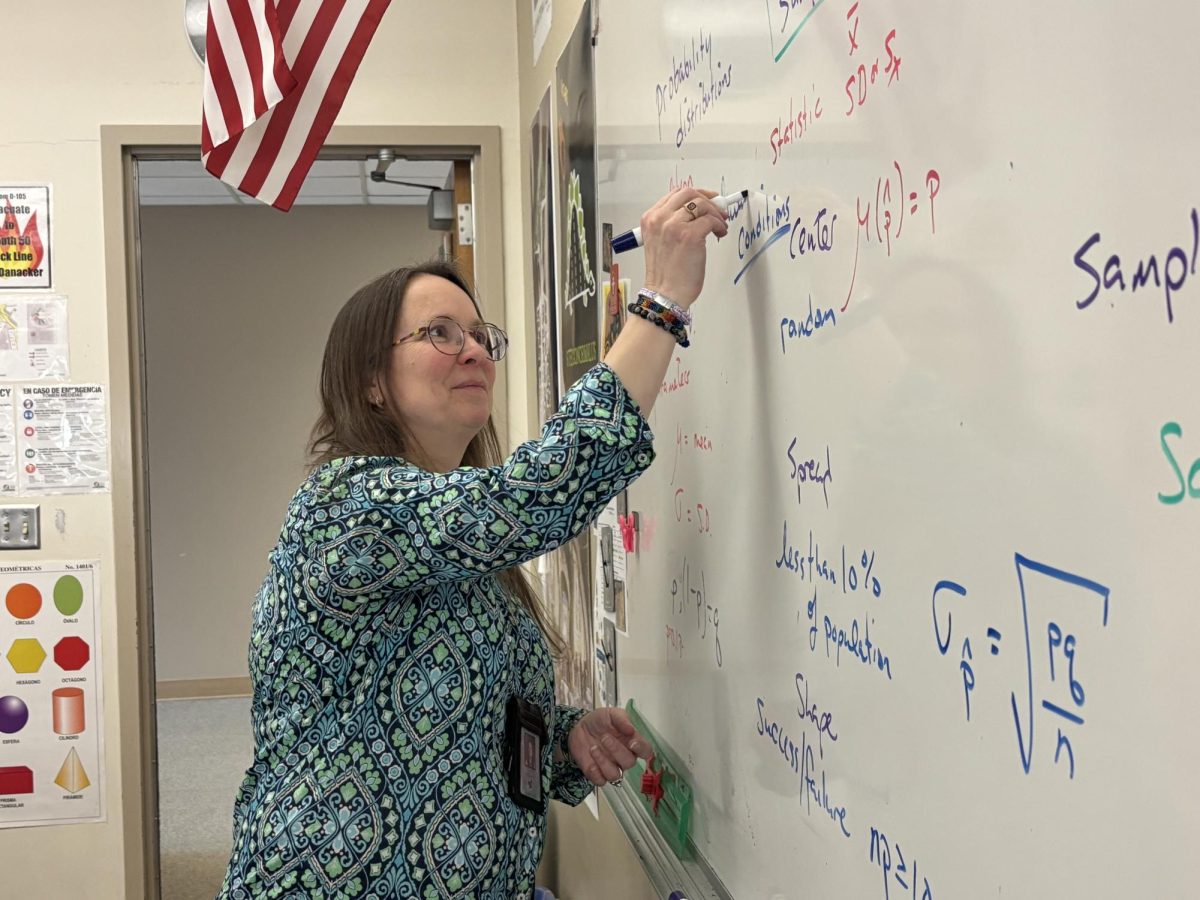
”Even if they don’t take the AP test, [students] start to understand what the expectations are at the college level,” Hilarie Roberts, an AP Calculus AB and AP Statistics teacher at Silver Creek, said.
This new exposure to a different style of learning will help students in preparation for college. AP classes compress more material, which will help students in preparation for college and beyond.
The compressed material, alternatively, can create challenges related to the pace of content delivery. The differences in AP class styles compared to high school subjects can help “…to prepare for college because those are higher level classes with more information packed into a shorter amount of time, which mimics an AP style class,” Novacek said.
Another advantage of taking more advanced math classes is that, by passing the exam at the end of the year, students are able to gain college credit.
”It’s really advantageous for our students that all of our Pre-CALC is now AP Pre-CALC, then everybody can get college credit for work that they were doing at the college level anyway,” Roberts said.
While many benefits exist for enrolling in AP math class, there are also restrictions from teachers that limit the content and the scope of what can be taught.
”There’s a very specific curriculum, a very specific timeline and a very specific set of outcomes that have to be achieved, which really confines what we can do in class time,” Kay Van Danacker, an Algebra I, Algebra II, and AP Statistics teacher, said.
Due to these tight constraints, teachers often cannot explore topics beyond the prescribed curriculum or add their own insights. These restrictions can make the class work more confined and can affect students’ learning progression.
If there were an option for an honors class, it would allow teachers to ”…have a little more flexibility to go deeper into topics that interest students or to spread out the curriculum a little bit, instead of keeping this very fast-paced, college-level timeline,” Van added.
Some students also believe that re-establishing some of the honors courses would help address these issues. In past years, Honors Pre-Calculus was offered; however, after deciding that the honors class was very similar to the AP course, it was decided that the class would just transfer into an AP.
“I think that having honors options up to a certain degree would be helpful, bringing back Honors Pre-Calculus and Honors Statistics,” Vo said.
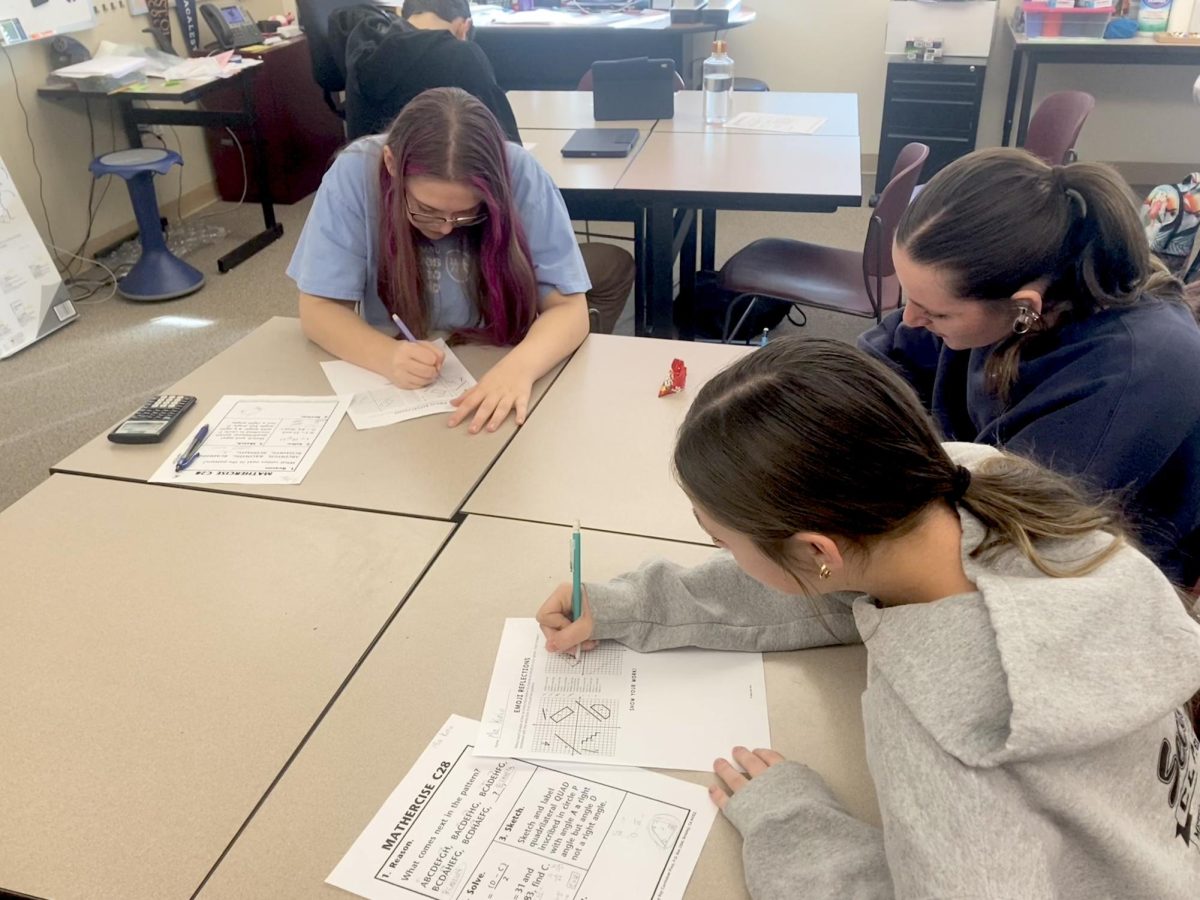
There are a few opportunities for students at Silver Creek who want to keep pursuing math, which include classes like Math of Games and Non-Euclidean Geometry. Although, both classes require a minimum of 15 students to run. Another aspect that Silver Creek has to offer is the Math Club, which is run by Carla McManaway, an Algebra II and AP Pre-Calculus teacher. Many other schools in the St. Vrain Valley School District also offer similar opportunities.
“There’s also a new program that’s district-wide, housed at Skyline, Data Science,” Erick Finnestead, the principal at Silver Creek High School, said. “[It’s a] two-year program, which gives [students] college credit in data science.”
Along with courses offered within the district, there are also classes that students can take from Front Range Community College (FRCC).
“I’ve worked out with our concurrent enrollment office that when kids want to pursue [math] at Front Range, there’s a new ability for them to take College Algebra, whereas previously it was AP Pre-CALC only,” Finnestead said.
Students are also able to access different tasks to improve their mathematical education at Silver Creek besides taking the more challenging courses.
“There are so many things that we could do that aren’t for college credit for improving our mathematical minds and keeping our skills sharp, and learning more things that relate to math,” Van said.
While taking into consideration all of the restrictions on students and the different classes that are offered or not offered, it’s still important to recognize the support that students can have from teachers within their classes.
“I truly believe every student can be successful in [AP] classes if they want to be and they have a supportive teacher,” Roberts said.