







![Hosting the SCLA Casptone Mentor Dinner outside allowed for more attendees on September 27, 2021 at Silver Creek. This event would’ve usually been held inside. According to Lauren Kohn, a SCLA 12 teacher, “If we have a higher number of people, as long as we can host the event outside, then that seems to be keeping every[one] safe”.](https://schsnews.org/wp-content/uploads/2021/11/sxMAIGbSYGodZkqmrvTi5YWcJ1ssWA08ApkeMLpp-900x675.jpeg)

Popcorn reading. There’s a short story plastered from the projector at the front of a room. A student at the back of the room raises their head upon hearing their name. A crowd of eyes turn toward their chair, waiting for words to spill out of their mouth.
They try to speak, muttering aloud the black words on the screen in a jumbled, stuttering fashion. They’re a 12th grader in their College-Prep English (CP) class, hardly able to read a simple short story out loud. It’s not the pressure of the eyes around them, but the fact that they’ve hardly had to read like that before; they’re out of practice, if they’ve ever been in.
The teacher furrows her eyebrows, wondering why this has been such a common occurrence in her recent years of teaching.
“I see students have far less ability to focus,” Lauren Kohn, a CP English 12 teacher at Silver Creek, said. “They have far less perseverance and grit when it comes to finding information, just finding information. Everybody wants that one and done response, and they don't want to try again after the first attempt, so to speak.”
The “literacy crisis” of the 21st century has been rising in teacher-consciousness in the past few years, as they’ve noticed more and more students struggling with what was previously expected of the average student. This is only expected to get worse.
“I think that the onset of AI and our inability to focus for long periods of time, or the decrease in that ability, is certainly a problem,” Kohn said.
Over the years, the words “The education system is broken” has been spoken enough times for people to understand that there is a problem, a hole somewhere, but there has not yet been a consensus on where it is or how to fill it. All we see is water at our ankles, with an unknown reason as to why so many students are struggling with what used to be easy.
“I think a big part is … the No [Child] Left Behind policy,” Emma Jakobsen, a senior at Silver Creek, said. “They're kind of just forced to put kids that shouldn't be going forward into a higher grade just so they graduate on time, even if it's not what's the best for the students or the teachers.”
The No Child Left Behind (NCLB) Act is one that comes up often in conversations about the efficiency of education, though many people don’t know exactly what it does.
In 2002, George W. Bush signed a law that changed education for all Americans. A basic rundown for the long Act is that education saw a shift from local control to nation-wide standardized testing. Reading the definition of the Act, however, it’s difficult to place how the NCLB Act causes students to get pushed on to the next grade-level.
The relationship between social promotion (pushing students forward) and the NCLB Act is a contentious one, as many people point to NCLB as being at fault for the former. However, it begs the question, “How is standardized testing making less people fall behind?”
What many people point to is the heavy reliance after NCLB on metrics as a measure of how well a school is performing, and by extension, how much funding it gets from the U.S. government. As a result of this, many schools lower the bar that students have to pass in order to be successful. Since statistics have shown that students that get held back are less likely to graduate, schools don’t like holding students back.
Caleb Martinez-Englerth is a 21-year-old former student of Longmont High School who struggled with the school’s adherence to holding him back.
“I realized I was failing all of my classes and I was leagues behind the rest of my schoolmates, and I was like, ‘Oh, I need to be held back,’” Martinez-Engerth said. “‘I'm going to fail, it's going to be bad.’”
He recounted meeting with his counselor, after having discussed his need for being held back with his parents.
“They pushed back against that tooth, nail and claw,” he said. “I sat there for hours, for like, two weeks trying to convince this lady that I needed to be held back.”
Martinez-Englerth ended up having to switch to home-schooling through the district out of frustration with how the school was treating his struggles. He was never held back, and he describes how he still feels behind, even in adulthood, with what he should’ve learned in high school. One reason he points to this problem is the way schools measure success.
“Something that I hate about the school system is the fact that it is so dead set on tests being its way of finding out how much students have learned,” Martinez-Englerth said. “I think there's some room for tests to be used, but it shouldn't be our only metric.”
Two other main factors seem to lie at the foot of where many students feel high school lacks to educate them properly.
Lor Vincent, a Silver Creek graduate, now attending University of Colorado as a freshman, describes how they felt unprepared by their high school education.
“Taxes,” Vincent said. “My [Personal Finance Literacy] class failed me … They told us how to invest, kind of, but it was very brief, because it was one semester, and I ended up having to ask my parents so many questions the first time I filed taxes.”
How life skills like filing taxes, buying a car, and paying mortgages, to name a few, should be treated in high school education is a difficult question for many to answer. The question lies between how much should be expected of the student’s family, and how much should be expected of general education. When it should be taught, earlier or later. Questions about how involved topics like cooking, sex-ed, and finances should be for every student in high school is something nobody seems to be able to agree on.
Many juniors and seniors, especially in the latter half of the school year, are now reflecting on how prepared they feel they are to enter the “real world.” Most feel incredibly unprepared for what is to come.
“I definitely think there's a lot of lack of things specifically at our school that can prepare you for being an adult,” Hailey Donahue, a senior at Silver Creek, said. “We have PFL here, but other schools offer culinary classes and stuff.”
For Career Evaluation and Technology Center (CETC) classes, though many people may be interested in taking them, the classes are out of the way and inconvenient for most students.
“They have a ton of classes that do teach you skills like that, but they only send a specific amount of people, they're at a [specific] time, and they're out of the way,” Donahue said.
Many students turn away from the CETC classes because they interfere with their high school schedules, and they have to get on a bus or drive to the campus. That makes access to these life skills a lot more difficult to acquire in a school setting.
“Culinary classes…[an Home Education] used to be more central to what high school is about,” Bryon Booher, AP history teacher at Silver Creek, said.
The biggest gripe a lot of students have with their high school education is the lack of preparation for the real world, whether it be in basic life skills, or because they feel like what they are learning is not going to be useful once they step off the graduation podium.
Cosette Murphy is a ninth grader, going into her second semester of high school. What she feels seems akin to what many students echo throughout their high school career.
“If I want to be like a math teacher, I would think that the math that I'm learning is good, but I don't think that it's gonna be beneficial for my future,” Murphy said. “Really, I feel like we should learn more life skills.”
Most teachers, however, look at what they are teaching from a wider lens. English is not just reading books. History is not just names and dates. And math is not just graphs and formulas.
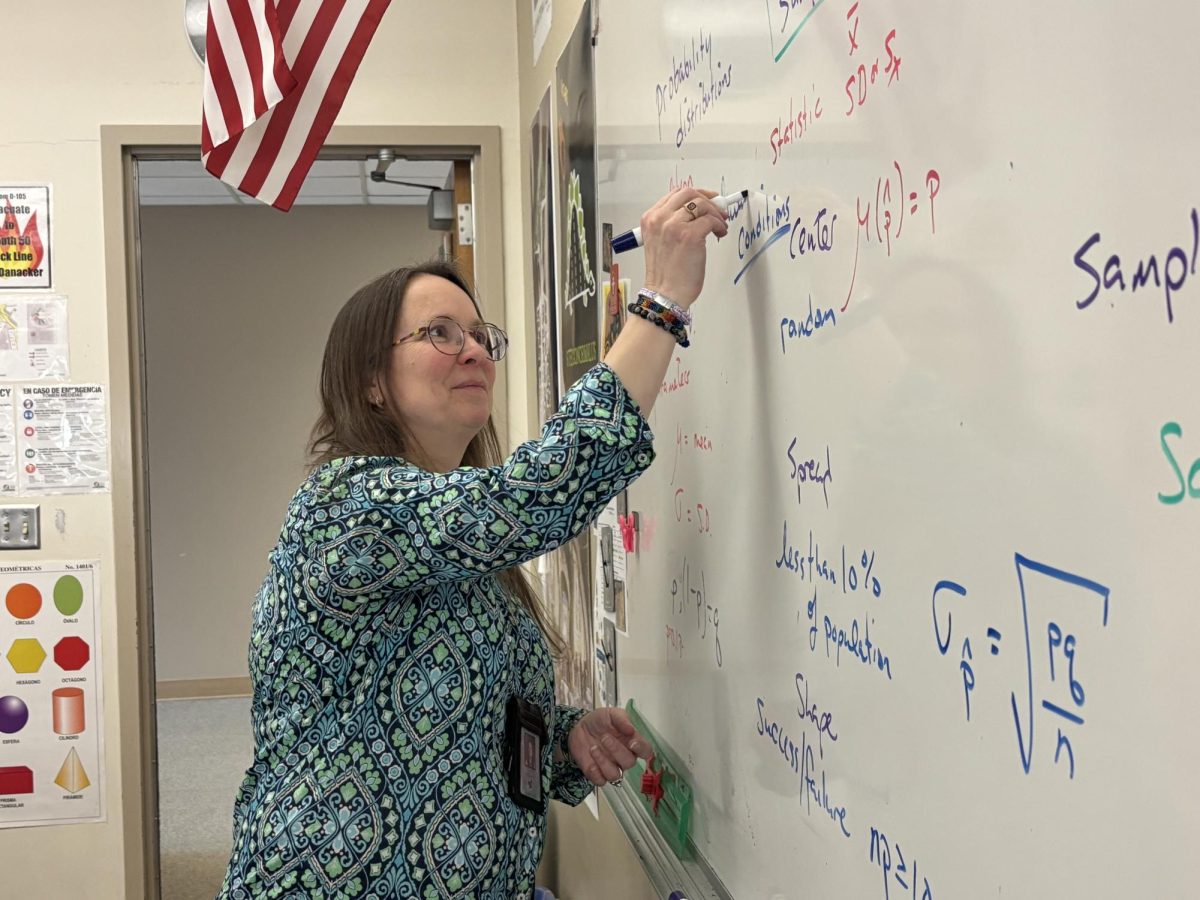
Ericka Pilon, Algebra I and II teacher at Silver Creek, is connected to many of her previous students after graduation. Most of the students she’s still in touch with are those who have struggled with math in the past. “The kids come back usually and say things like, ‘Yeah, like, I can see the point in that,’” Pilon said. “It's not necessarily the equations. They're probably not going to use a rational equation ever again in their life, but the problem solving and the questioning strategies they use to get through that is what they're learning.”
For some teachers, math might be soothing, a challenging puzzle to relax the mind. For others, it may stem from a passion for writing. Some may love learning and speaking about the past. For all, the subject is merely the paint brush they use for their art, a means of teaching what they hope students will get out of their experience in their classroom.
“I am teaching my students history, and how to think about history,” Bryon Booher, teacher of AP United States History and AP African American Studies, said. “To formulate their own opinion, and how they [can] be an active participant. Even though my class [is] about the past, I want them to be like a positive force on the future.”
Many rely less on the content itself, but more on what will be retained even after a test is taken.
“The main purpose of education is to teach people to think,” Lauren Kohn, College-Prep (CP) English 12 teacher at Silver Creek, said. “It's not necessarily about the content as much as it is about how to think, and how to persevere through thinking about complex topics.”
Although what is learned in high school may feel like a waste of time, a blur of numbers and long words and names of people who died hundred of years ago, what is retained from those lessons if not for nothing. It’s difficult when skills like how to study, how to work hard for an outcome and receive it, and how to manage a difficult home-life while finals are approaching are hard to measure.
“I hate pretty much all standardized tests,” Samuel Brownell, Algebra and Geometry teacher at Silver Creek, said. “I dare you to find me a standardized cohort of students. You're not going to do it. There's too much individuality, and that's a good thing. Diversity is fantastic. If we were all the same, what? Then we wouldn't need grades.”
As more students that have been growing up with the No Child Left Behind Act are graduating, the consequences of the policy on the population will reveal itself more over time, whether it be good or bad. But there are also ways to appreciate the concrete in between the cracks in the meantime, what hasn’t been broken. The education system has never worked perfectly, but hopefully all we can do is work in the right direction.
“They used to say in the late 90s, early 2000s, they would say, ‘21st Century Education,’” Booher said. “Well, now we're 25 years in. Hopefully we figured out what that means.”